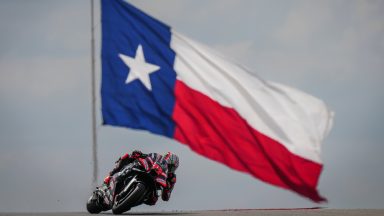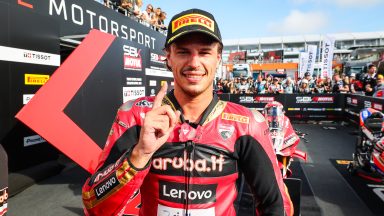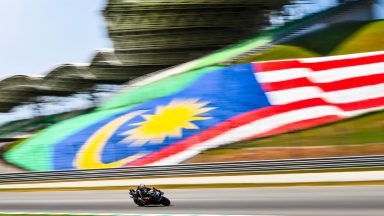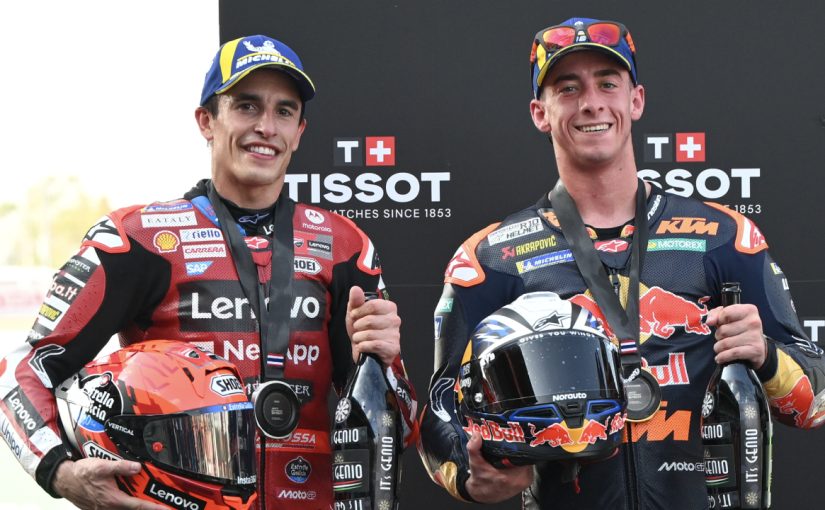
Pedro Acosta hailed Marc Marquez as one of the greatest riders in MotoGP history, pointing to the Ducati star’s remarkable comeback from injury and adversity.
The Red Bull KTM Factory Racing rider discussed Marquez during an appearance on the Gypsy Tales Podcast, where he reflected on the nine-time world champion’s return to the top of the sport.
After suffering a series of injuries that threatened to derail his career, Marquez fought his way back to claim the 2025 MotoGP world title and secured his first victory of the 2026 season at the Hungarian Grand Prix.
“If he’s not the G.O.A.T., then he’s the same level as Valentino [Rossi],” said Acosta.
“If you just think about his comeback to MotoGP, winning on the second try, and how much he suffered.
“For me, what makes Marc one of the greatest is not how much he achieved, it’s how much it cost to take it back.
“When you have the crown and it goes away, normally we have to understand [it can happen when] younger riders like [Fabio] Quartararo, Pecco [Bagnaia], [Jorge] Martin come.
“These guys are talented, and you are coming back from really difficult years to take back what is yours.”
Venus and Serena Williams will reunite at Wimbledon later this month after receiving a wildcard entry into the women's doubles draw.
The former world number ones will team up for the first time since the 2022 US Open.
The announcement is another step in Serena's comeback after the 44-year-old returned to competitive tennis earlier this month following an absence of nearly four years.
She recently competed in doubles alongside Victoria Mboko at the HSBC Championships and is scheduled to pair with Karolina Muchova at the Berlin Open this week.
Serena has won 23 Grand Slam singles titles and seven Wimbledon crowns, while Venus lifted the singles trophy five times.
Together, the sisters captured 14 Grand Slam doubles titles, including six at Wimbledon.
Wimbledon has crowned some of the greatest champions in tennis history, from Roger Federer and Martina Navratilova to Novak Djokovic and Serena Williams.
Yet for every player who lifted the famous trophy at the All England Club, there are others who left London wondering what might have been. Despite winning Grand Slam titles, reaching world No. 1 and dominating their respective eras, several of the sport's biggest names were unable to conquer the grass courts of Wimbledon.
Ahead of the 2026 edition, which will be broadcast live on SPOTV NOW, here are 10 notable players who enjoyed remarkable careers but never managed to win one of tennis' most prestigious titles.
Ivan Lendl
Few players achieved more during the Open Era than Lendl. The former world No. 1 won eight Grand Slam singles titles and 94 ATP tournaments, establishing himself as one of the dominant figures of the 1980s. Wimbledon, however, remained the one major missing from his resume. Lendl reached the final in 1986 and 1987 and made five semi-finals at the All England Club, but was unable to convert those opportunities into a title.
Monica Seles
Seles was one of the most successful players of her generation, winning eight out of nine Grand Slam singles titles and reaching world No. 1 before the age of 20. However, she never won at Wimbledon, with her best result coming in 1992 when she lost to Steffi Graf in the final. Seles never returned to the championship match, especially after the infamous stabbing attack in 1993 that sidelined her for more than two years, with quarter-final appearances representing her best results subsequently at the All England Club.
Justine Henin
Henin enjoyed success on both clay and hard courts throughout her career, but Wimbledon proved elusive. The Belgian reached the final twice, losing to Venus Williams in 2001 and Amelie Mauresmo in 2006, leaving Wimbledon as the only Grand Slam title missing from her collection.
Mats Wilander
Wilander collected seven Grand Slam singles titles and rose to world No. 1 during one of tennis' most competitive eras. The Swede won major titles on clay and hard courts, including three Australian Open crowns and three Roland Garros titles. Wimbledon was the exception, as Wilander never progressed beyond the quarter-finals, making it the only Grand Slam where he failed to reach a final.
Arantxa Sanchez Vicario
Vicario won four Grand Slam singles titles and spent 12 weeks as world No. 1. Although best known for her achievements on clay, the Spaniard also produced some of her strongest tennis at Wimbledon. The Spaniard reached back-to-back finals in 1995 and 1996 but lost both matches to Steffi Graf. Those runner-up finishes remained the closest she came to winning the grass-court major.
Marcelo Rios
Rios occupies a unique place in tennis history as the only male world No. 1 in the Open Era who never won a Grand Slam singles title. Wimbledon stood out as the Chilean’s least successful major, as his best result at the All England Club was a fourth-round appearance in 1997.
Andy Roddick
Roddick came closer than most to ending his Wimbledon drought. The former world No. 1 and 2003 US Open champion reached three Wimbledon finals in 2004, 2005 and 2009. Unfortunately for the American, all ended in defeat to Roger Federer, including their memorable 16-14 fifth-set battle in 2009.
Jim Courier
Courier was one of the dominant players of the early 1990s, reaching six Grand Slam finals in the space of three years. Four resulted in Australia Open and Roland Garros success, but the former world number one came up short at the US Open and Wimbledon. For the latter, he lost to Pete Sampras in the 1993 final.
Ilie Nastase
Nastase was one of the leading figures in men's tennis during the 1970s, winning two Grand Slam singles titles and more than 60 career tournaments. He had several deep runs at Wimbledon, including reaching the finals in 1972 and 1976, but defeats to Stan Smith and Bjorn Borg denied him a title.
Guillermo Vilas
Long before Argentina became a regular force in men's tennis, Vilas helped put the country on the global tennis map. The left-hander won 62 singles titles including four Grand Slam honours during a remarkable career. While he enjoyed major success on clay and hard courts, grass was a tougher challenge. Vilas never progressed beyond the Wimbledon quarter-finals, leaving the tournament as one of the few notable gaps in an otherwise outstanding career.
MotoGP returns to Brno this weekend for the 2026 Grand Prix of Czechia, one of the championship's most historic venues and a circuit that has produced plenty of memorable moments over the years.
Ahead of the highly anticipated action, live on SPOTV NOW, here are five things to know about this weekend's race.
Marc Marquez closing in on Brno record
Fresh from his victory at the Hungarian Grand Prix, Marc Marquez heads into the weekend as one of the most successful riders in Brno history. The Ducati rider has won four times at the Czech circuit, triumphing in 2013, 2017, 2019 and 2025. Another victory this weekend would see him move clear of Valentino Rossi for the most premier-class wins at Brno since MotoGP's rebranding in 2002.
Crutchlow returns to scene of historic maiden win
Castrol Honda LCR rider Cal Crutchlow will once again deputise for the injured Johann Zarco this weekend. The Czech circuit holds a special place in the Briton's career after he claimed his maiden MotoGP victory there in 2016. The triumph also delivered LCR's first-ever premier-class win and ended a 35-year wait for a British rider to stand on the top step of a 500cc/MotoGP podium.
Pole position offers no guarantee of success
Starting from pole position has historically provided not much advantage at Brno. Since 2002, polesitters have converted their advantage into victory only nine times from 20 races, a success rate of 45 per cent. The trend has become even more pronounced in recent years, with only four of the last 10 Grands Prix of Czechia winning from pole position.
Will there be sixth straight different winner?
The last five races have produced five different winners: Alex Marquez (Jerez), Jorge Martin (Le Mans), Fabio Di Giannantonio (Barcelona), Marco Bezzecchi (Mugello) and Marc Marquez (Balaton Park). A new winner in the Czech Republic would make it six different winners from six consecutive races, matching the best run from the 2025 season.
The modern MotoGP record remains eight different winners from eight races, a feat achieved in both 2016 and 2020.
The work is not done for MotoGP teams and riders when the chequered flag falls on Sunday. They will remain at Brno for the first official test featuring MotoGP's new 850cc machinery and Pirelli tyres ahead of the 2027 regulation overhaul.
With Wimbledon 2026 set to begin later this month, attention is once again turning to the world's oldest tennis tournament.
First held in 1877, Wimbledon remains one of the most prestigious events in sport and is known for traditions such as its grass courts, all-white dress code and royal patronage. Yet beyond the trophies and famous champions lies a collection of records, milestones and historical moments that have shaped the tournament over nearly 150 years.
Here are 10 lesser-known facts from Wimbledon history ahead of this year's Championships, which will be broadcast live on SPOTV NOW.
The first-round match that changed tennis forever
John Isner and Nicolas Mahut produced the longest match in professional tennis history during the first round of Wimbledon in 2010. Played across three days, the contest lasted 11 hours and five minutes before Isner eventually prevailed 6-4, 3-6, 6(7)-7, 7-6(3), 70-68. The deciding set alone lasted more than eight hours.
The match became one of the defining moments in modern tennis and played a significant role in the eventual introduction of final-set tiebreak rules across the Grand Slams.
Wimbledon's first final-set tiebreak in 2019
After introducing a final-set tiebreak at 12-12 in 2019, Wimbledon did not have to wait long for the new rule to be used. The first singles match to require the tiebreak was the men's final between Novak Djokovic and Roger Federer. Djokovic saved two championship points before winning 7–6(5), 1–6, 7–6(4), 4–6, 13–12(3) in four hours and 57 minutes. The contest remains the longest Wimbledon singles final on record.
Won more points but lost the final
The 2019 men's singles final also produced an unusual statistical anomaly. Although Djokovic won, Federer actually won more points across the match, finishing with 218 points compared to the Serbian’s 204. It remains one of the rare occasions in a Grand Slam final where the runner-up finished with more total points than the champion.
Only two women won Wimbledon in both the Amateur and Open eras
The Open Era began in 1968 when professional players were allowed to compete alongside amateurs at Grand Slam tournaments. Only Billie Jean King and Margaret Court managed to win Wimbledon singles titles both before and after the transition, placing them in a unique category in the tournament's history.
Britain's wait for a women's singles champion stretches nearly half a century
Virginia Wade remains the last British woman to win the Wimbledon singles title. She defeated Betty Stöve in the 1977 final during Queen Elizabeth II's Silver Jubilee year, with the monarch watching from Centre Court. Nearly five decades later, no British woman has repeated the achievement despite several deep runs from home players.
The wild card who won the whole thing
Goran Ivanišević arrived at Wimbledon in 2001 ranked No. 125 in the world and entered the tournament via a wild card. The Croatian, who had previously lost three Wimbledon finals, defeated Carlos Moya, Andy Roddick, Marat Safin, Tim Henman and Patrick Rafter en route to his sole Grand Slam title. He remains the only wild-card player to win a Wimbledon singles championship.
Only two men won Wimbledon without dropping a set in the Open Era
While several women's singles players have won Wimbledon without dropping a set, it has only happened twice in men's singles during the Open Era. Only Björn Borg (1976) and Roger Federer (2017) have completed their title runs with a perfect set record.
132 years without a roof
For most of Wimbledon's history, play remained entirely dependent on the weather. Famous matches including Ivanišević's 2001 title triumph and the classic 2008 Federer-Nadal final were disrupted by rain delays. A retractable roof was finally installed above Centre Court in 2009, allowing play to continue regardless of conditions and reducing the risk of lengthy weather-related interruptions.
When Wimbledon was cancelled
Wimbledon has only been interrupted during three periods in its history: World War I (1915-1918), World War II (1940-1945) and the COVID-19 pandemic in 2020. The most recent cancellation marked the first interruption to the tournament in 75 years.
Double-bagel finals in both Amateur and Open eras
A 6-0, 6-0 scoreline in a singles final is extremely uncommon, even more so in a Grand Slam. It has happened only three times in major history, and Wimbledon is the only Grand Slam to have produced double-bagel champions in both the Amateur and Open eras. The All England Club first witnessed the feat in 1911 when Dorothea Lambert Chambers defeated Dora Boothby, before Iga Świątek repeated it 114 years later with her victory over Amanda Anisimova.