Zeng Jian leads host country’s challenge at 2026 Singapore Smash
By Lee Seng Foo7 months ago
(World Table Tennis)
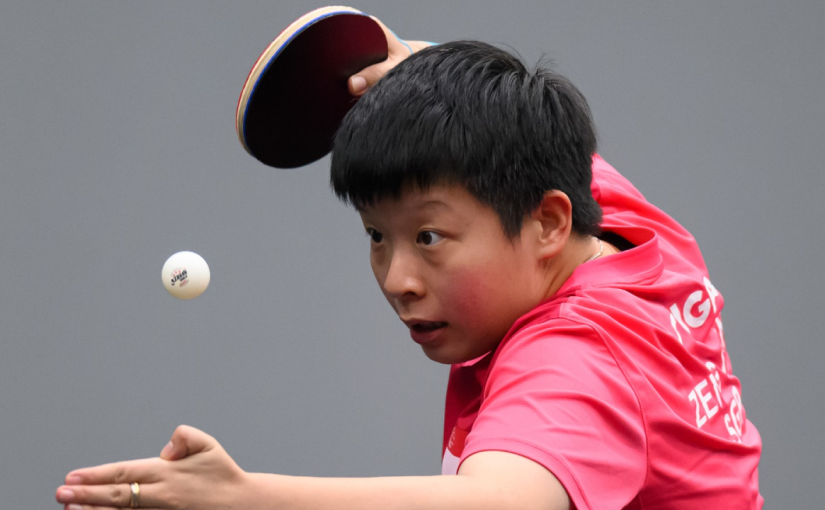
Zeng Jian is among four Singaporean table tennis players set to compete at the 2026 Singapore Smash.
Taking place at the Resorts World Sentosa from February 19 to March 1, the tournament is the first WTT Grand Smash event of the season and carries a total prize purse of USD 1.55 million.
Many of the world’s top players are slated to take part, such as defending singles champions Lin Shidong and Sun Yingsha as well as 2026 WTT Champions Doha winners Lin Yun-ju and Zhu Yuling.
Other big names on the entry list include world number one Wang Chuqin and WTT Finals Hong Kong 2025 champions Tomokazu Harimoto, Wang Manyu and the mixed doubles pairing of Lim Jonghoon and Shin Yubin.
Zeng, ranked 37th in the world, is joined in the women’s singles by compatriot Ser Lin Qian, who begins her campaign in the qualifying rounds.
MotoGP heads to the Red Bull Ring this weekend for the Austrian Grand Prix, with the championship arriving in Spielberg finely poised after a dramatic turnaround at the top of the standings.
Marc Marquez and Jorge Martin are level on 274 points, with the defending champion leading on countback, while Pedro Acosta heads to KTM's home race in his best form of the season.
Here are five fun facts to know ahead of the 2026 Austrian Grand Prix from September 18-20, live on SPOTV NOW.
After the Italian Grand Prix, Marquez trailed then-championship leader Marco Bezzecchi by a massive 102 points. Just seven rounds later, victory at the San Marino Grand Prix moved Marquez level with Martin on 274 points.
Marquez has therefore erased the largest deficit to take the championship lead in the MotoGP era, surpassing the 91-point gap Francesco Bagnaia overturned in 2022.
The latter, however, still holds the record for the biggest comeback to win the MotoGP title after completing the job against Fabio Quartararo that season.
A decade of survival
Of the riders entered in the MotoGP class when Austria returned to the calendar in 2016, only Marquez, Maverick Vinales and Jack Miller remain on the grid a decade later.
Miller did not start the 2016 race after suffering a warm-up crash, while Vinales remains doubtful for this weekend as he continues his recovery from a shoulder injury.
Should Vinales be ruled out again, Marquez would be the only full-time rider to start both the 2016 and 2026 Austrian Grands Prix. Incidentally, Vinales' replacement in recent rounds, Pol Espargaro, was also on the grid 10 years ago.
Another win for Ducati?
The Red Bull Ring has become a Ducati stronghold since MotoGP returned to Austria in 2016. The Italian manufacturer has won ten of the 12 premier-class races staged at the circuit over the past decade, including the additional Styrian Grands Prix held in 2020 and 2021.
Andrea Iannone, Andrea Dovizioso, Jorge Lorenzo, Martin and Francesco Bagnaia have contributed to that dominance, while Marquez joined the list when he finally ended his long wait for an Austrian victory last year.
Watch out for the Shark
Only one manufacturer has prevented a complete Ducati sweep at the Red Bull Ring since 2016: home team KTM. Miguel Oliveira delivered the Austrian manufacturer a victory at the 2020 Styrian Grand Prix before Brad Binder produced his unforgettable slick-tyre triumph in the rain at the 2021 Austrian Grand Prix.
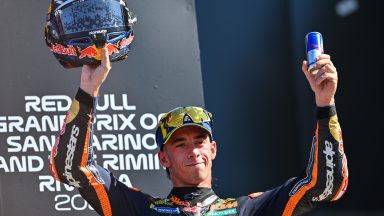
With that in mind, do not rule out Pedro Acosta becoming KTM's third MotoGP winner on home soil and finally ending his own wait for a maiden MotoGP Grand Prix victory.
The Spaniard heads to Spielberg with back-to-back podiums after finishing second at Aragon and third at San Marino, with KTM's recent engine work helping the RC16 return to the front.
What better way for "The Shark" to sign off his final Austrian Grand Prix as a KTM rider before joining Ducati than with a home victory?
The inaugural FIM Harley-Davidson Bagger World Cup reaches its conclusion at the Red Bull Ring this weekend, with four riders still in contention for the title.
Archie McDonald leads the standings with 174 points, just seven ahead of Eric Granado on 167, while Oscar Gutierrez sits third on 148 and Andrea Iannone remains in the hunt on 147. If Iannone manages to defy the odds, it would be another landmark triumph for the Italian at the venue.
A decade ago, he claimed his first and only MotoGP victory at the Red Bull Ring, ending Ducati's six-year premier-class win drought. This weekend, the same circuit could provide the setting for Iannone to become the inaugural Bagger World Cup champion.
Trinity Rodman pulled off a remarkable dash from Washington to New York to watch boyfriend Ben Shelton in the closing stages of the US Open final on Sunday.
The United States football star faced a major scheduling clash after her NWSL club Washington Spirit hosted Boston Legacy FC at 1pm, just an hour before Shelton began his first Grand Slam final against Alexander Zverev at Arthur Ashe Stadium.
Rodman played in the Spirit's 3-0 defeat before immediately turning her attention to making the journey of more than 300 kilometres to New York.
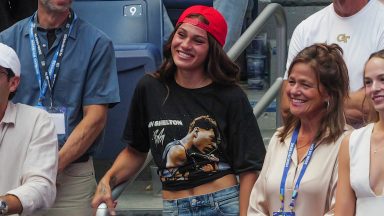
Despite the tight turnaround, the 24-year-old managed to reach Flushing Meadows before the final was over and appeared in Shelton's player box wearing a shirt bearing his face.
Her arrival came late in the match as Shelton attempted to fight back against Zverev, who eventually secured a 6-3, 7-6(2), 5-7, 6-2 victory to win his first US Open title.
"I knew she was coming. I knew it was going to be pretty close to impossible to get here, but even just making the effort and trying is insane," Shelton said.
"She kind of showed up as I was losing, which for her probably sucked."
Zverev also acknowledged Rodman's late arrival during the trophy presentation, joking about how she had managed to make it to New York after playing earlier in the day.
"Trinity, I thought you had a game today," Zverev said.
"You're the lucky charm... not today, but usually."
Rodman had been a regular presence during Shelton's run at Flushing Meadows, including his quarter-final victory over defending champion Carlos Alcaraz that finished at 3:33am, the latest finish in US Open history.
She was back with the Spirit for training in Virginia just hours after that match.
Shelton's defeat ended his bid to become the first American man to win a Grand Slam singles title since Andy Roddick at the 2003 US Open, but his run marked his first appearance in a major final.
Alexander Zverev paid an emotional tribute to his mother after winning the US Open, crediting her for refusing to let his childhood diabetes diagnosis limit his ambitions in tennis.
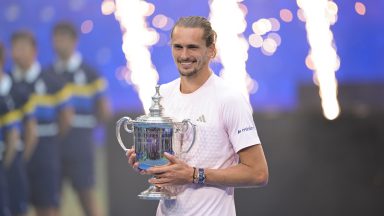
The German defeated Ben Shelton 6-3, 7-6(2), 5-7, 6-2 in Sunday's final at Arthur Ashe Stadium to claim his first US Open crown and second Grand Slam title.
Zverev, who was diagnosed with Type 1 diabetes at the age of four, revealed that doctors had warned his family that the condition could severely restrict his ability to play sport.
His mother Irina, however, refused to accept that prognosis and encouraged him to pursue whatever career he wanted.
"I want to thank one person who actually doesn't even watch my matches, but she's the most important person in my life," Zverev said during the trophy ceremony.
"When your four-year-old son gets diagnosed with diabetes and the doctors tell you he's going to have a very limited life in sports, you have to be a very strong mother to walk out of those doctors' offices and say, 'My son is going to be whatever he wants to be.'
"If he wants to be a tennis player, he's going to be a tennis player. But this disease is not going to define his life."
Zverev has managed the condition throughout his career, requiring him to monitor his blood glucose levels and take insulin when necessary, including during matches.
He kept his diagnosis largely private during the early years of his career before publicly revealing it in 2022, when he also launched the Alexander Zverev Foundation to support children and young people with diabetes.
"My mother is the most important and strongest person I know. She had to be a very strong woman to do what she did,” Zverev added.
25 years after his diagnosis, Zverev now won two of tennis' biggest prizes in the space of three months.
The 29-year-old claimed his maiden Grand Slam title at the French Open in June before adding the US Open crown, having previously lost the 2020 final at Flushing Meadows to Dominic Thiem.
His New York triumph also capped a remarkable Grand Slam season in which he reached at least the semi-finals at all four majors.
Alex Rins has announced he will retire from motorcycle racing at the end of the 2026 season despite receiving offers to continue his career in Superbike World Championship (WorldSBK).
The 30-year-old was already set to leave Yamaha when his contract expires at the end of the year, but had been linked with a switch to WorldSBK as he looked for his next move.
However, Rins confirmed ahead of the San Marino Grand Prix that he has decided to walk away from two-wheeled racing altogether after 14 years competing on the world stage.
"I will not go to Superbike next year," Rins said.
"I had two possibilities there. I really want to say thanks to them because they were quite interested in me. But I found another thing that really motivates me more.
"As I told you some races ago, I have a really interesting project in mind that I can’t reveal because it’s not done 100%."
Rins has yet to reveal details of his next project, leaving his plans beyond the 2026 season unclear.
The Spaniard made his MotoGP debut with Suzuki in 2017 after finishing runner-up in both Moto3 and Moto2, and went on to claim six premier-class victories and 18 podiums.
He spent six seasons with Suzuki before the manufacturer withdrew from MotoGP at the end of 2022, prompting a move to LCR Honda.
Rins memorably won the 2023 Americas Grand Prix in just his third race with Honda, but his season was later disrupted by a serious leg injury suffered at Mugello.
He joined Yamaha in 2024 and has spent the past three seasons with the factory team, but will now bring his motorcycle racing career to an end when the current campaign concludes.
"I'm really happy. For sure it was difficult to choose, because all my life in MotoGP, in this championship, many fights, many races, many wins. 14 years, more or less," Rins said.
"So yeah, I will stop with two wheels."
Rins still has nine rounds remaining in his final MotoGP season, beginning with this weekend's San Marino Grand Prix at Misano.