The world’s leading tennis players will return to New York later this month for the 2026 US Open, the fourth and final Grand Slam tournament of the season.
Known for its energetic crowds, night sessions and hard-court battles, the US Open has developed a character unlike any of the other majors. Its history also contains remarkable achievements, unusual records and stories that stretch far beyond the action at Flushing Meadows.
Ahead of the 2026 US Open, which will be broadcast live on SPOTV NOW, here are 10 facts from the tournament’s history that may come as a surprise.
The tournament that never stopped
The US Open has been staged every year since the inaugural men’s tournament was held in 1881. The event continued through both world wars and the COVID-19 pandemic, remaining the only one of the four Grand Slam tournaments never to have missed an edition.
Even in 1917, after the United States entered World War I, the tournament went ahead under the name National Patriotic Tennis Tournament, with proceeds donated to the American Red Cross.
Most finals without trophy
Despite their glittering careers, Bjorn Borg and Evonne Goolagong Cawley share an unwanted US Open record, having each reached four singles finals without winning the title.
Borg finished runner-up in 1976, 1978, 1980 and 1981, losing twice each to Jimmy Connors and John McEnroe despite winning 11 Grand Slam singles titles elsewhere.
Goolagong suffered all four of her defeats in consecutive years from 1973 to 1976, falling first to Margaret Court, then Billie Jean King and twice to Chris Evert. The Australian won seven Grand Slam singles titles during her career, but New York remained out of reach.
The champion of every court
The US Open has been contested on three different surfaces during its history. It was played on grass from 1881 to 1974, switched to green clay from 1975 to 1977 and became a hard-court tournament when it moved to Flushing Meadows in 1978.
Jimmy Connors is the only player to have won the same Grand Slam tournament on all three. The American lifted the trophy on grass in 1974, clay in 1976 and hard court in 1978, before adding two more titles in 1982 and 1983.
The first outright triple crown of the Open Era
Margaret Court won the women’s singles, women’s doubles and mixed doubles titles at the 1970 US Open, completing what can be regarded as the first outright triple crown of the Open Era.
Court had technically achieved the feat at the Australian Open a year earlier, but there was an asterisk over her mixed doubles title, as the final was never played due to time constraints and both pairs were declared champions. The Australian Open’s official records list Court and Marty Riessen as sharing the 1969 title with Ann Haydon Jones and Fred Stolle.
There was no such caveat in New York. Court defeated Rosemary Casals for the singles title, partnered Judy Tegart-Dalton to win the women’s doubles and teamed up with Riessen to claim the mixed doubles crown, winning all three competitions outright.
Her singles triumph carried even greater significance as she completed the calendar Grand Slam, having already won the Australian Open, French Open and Wimbledon that year, and became the first woman to achieve the singles feat in the Open Era.
Emma’s fairytale run
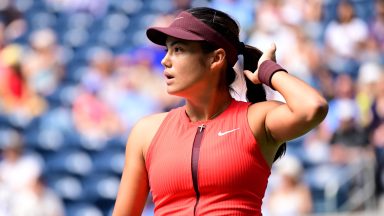
Emma Raducanu arrived at the 2021 US Open ranked 150th in the world and had to begin her campaign in qualifying. The then 18-year-old proceeded to win three qualifying matches and seven in the main draw, becoming the first qualifier in tennis history to capture a Grand Slam singles title.
Even more remarkably, Raducanu did not drop a set across any of her 10 matches, winning 20 in succession before defeating fellow teenager Leylah Fernandez in the final.
The first Grand Slam with a tiebreak
The tiebreak made its Grand Slam debut at the 1970 US Open as organisers looked for a way to prevent sets from continuing indefinitely. However, the original version was considerably more unforgiving than the format used today.
Known as the nine-point “sudden-death” tiebreak, it was won by the first player to reach five points. If the score reached 4-4, the ninth and final point decided the entire set, meaning there was no requirement to win by two.
The US Open eventually abandoned sudden death and switched to the 12-point tiebreak in 1975, where the first player to reach seven points with a margin of at least two won the set. Variations of that system subsequently became standard across the sport.
No defending men’s champion since 2008
Roger Federer defeated Andy Murray in the 2008 final to win his fifth consecutive US Open championship. No man has successfully defended the singles title since, leaving Federer as the last player to win the men’s trophy in consecutive years.
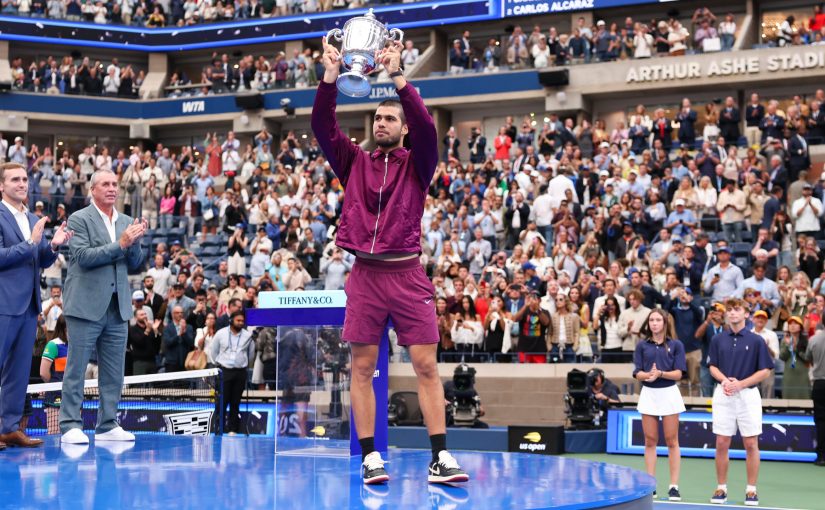
The streak has continued despite several multiple champions emerging in the years since. Rafael Nadal, Novak Djokovic, Jannik Sinner and Carlos Alcaraz have all returned to New York as defending champions without successfully retaining the title.
Seven years of Monday blues
The US Open men’s final was forced into an unscheduled Monday slot for five consecutive years from 2008 to 2012 due to weather disrupting the closing weekend and preventing the championship match from taking place on its traditional Sunday.
Organisers then deliberately extended the tournament to 15 days in 2013 and 2014, scheduling the men’s final on Monday to provide the finalists with a rest day following their semi-finals.
The result was an unusual seven-year sequence from 2008 to 2014 in which the men’s champion was crowned on Monday. The tournament returned to a Sunday men’s final in 2015.
From the Titanic to tennis champion
Richard Norris Williams won the US Championships in 1914 and 1916, but his tennis career had nearly ended before it properly began. Two years before his first singles title, the American was among the survivors of the Titanic disaster.
Williams suffered severe frostbite to his legs after the ship sank in the North Atlantic, with doctors reportedly recommending amputation. He refused and instead walked regularly aboard the rescue ship Carpathia to restore circulation.
Just months later, Williams won the 1912 US mixed doubles title before establishing himself as one of the leading players of his era. He later added two US doubles championships, a Wimbledon doubles title and an Olympic mixed doubles gold medal.
The winner who missed out on first prize
Arthur Ashe defeated Tom Okker to win the inaugural Open Era edition of the US Open in 1968, but the champion did not receive the tournament’s US$14,000 first prize.
Ashe was still registered as an amateur while serving as a lieutenant in the United States Army, making him ineligible to collect the prize money. The payment instead went to runner-up Okker, while Ashe received a US$20 daily allowance totalling just US$280 for the tournament.
There was another remarkable twist to Ashe’s summer. He had earlier won the final US Amateur Championships, making him the only player to win both the US amateur singles title and US Open singles crown in the same year.